
TL;DR — There isn’t just one.
The “strongest” muscle depends entirely on how you measure strength.
By absolute force, it’s the gluteus maximus.
Pound-for-pound, the masseter (jaw muscle) wins.
For lifelong endurance, nothing beats the heart.
Each champion dominates its own arena — and understanding why reveals more about your body than a single name ever could.
Ask a room full of people what the strongest muscle is, and you’ll get a dozen different answers. Some will swear by the tongue. Others will insist it’s the jaw. A few will point to the uterus or the heart. The truth is, they’re all correct — but only if you define the rules first.
Muscle “strength” isn’t a single, tidy measurement. It can mean:
- How much raw tension a muscle can generate (absolute force)
- How hard it pulls relative to its own size (specific tension)
- How long it can keep working without fatigue (endurance)
Scientists use all of these yardsticks, and each one crowns a different winner. That’s why, before we can answer the question, we have to decide what kind of strong we’re talking about.

3 Ways Science Measures Muscle Strength
Most casual conversations miss the real complexity. When researchers quantify muscle performance, they typically lean on three distinct criteria:
- Absolute force (peak contractile force): The maximum pull or push a muscle can produce, measured in pounds or Newtons. This is the number you’d use if you were building a robot and needed a motor that could lift a heavy box.
- Specific tension (force per cross-sectional area): How much force a muscle generates for every square centimeter of its fibers. This captures “efficiency” — the muscle’s quality, not just its size. A 2024 systematic review found that human skeletal muscle reliably produces about 26.8 N per square centimeter of fiber cross-section, a benchmark that lets us compare apples to oranges.
- Endurance and lifetime output: The ability to sustain contractions over time — minutes, hours, or even decades — without rest. This is measured by fatigue resistance, total workload, or total repetitions over a lifetime.
Each lens reveals a champion that the others miss.

Absolute Force Champion: The Gluteus Maximus
If you define strength as “the biggest external pull a single muscle can generate,” the gluteus maximus takes the crown. This massive, fan-shaped muscle forms the bulk of your buttocks and is responsible for extending your hip — the motion that drives you up from a squat, pushes you forward when you sprint, and keeps you upright against gravity.
Why it wins:
- Its cross-sectional area is enormous. The gluteus maximus has one of the largest physiological cross-sectional areas (PCSA) of any muscle in the body, meaning it packs a huge number of contractile units in parallel.
- During explosive hip extension, like jumping or deadlifting, the gluteus maximus generates forces that dwarf those of smaller muscles. In trained individuals, isokinetic testing shows torque values well over 200 Nm at the hip — a feat no other single muscle can match for raw, external force production.
- Even compared to the masseter, which can bite with shocking pressure, the gluteus maximus wins in untethered, whole-body power. The masseter’s bite force is impressive (up to 890 N in some healthy adults, according to a 2025 meta-analysis), but that force is constrained by a short lever arm and a controlled arc. The gluteus, by contrast, moves the entire body against the ground.
That said, if you pit the gluteus against the masseter on a per-square-inch basis, the story flips dramatically.

Pound-for-Pound Powerhouse: The Masseter
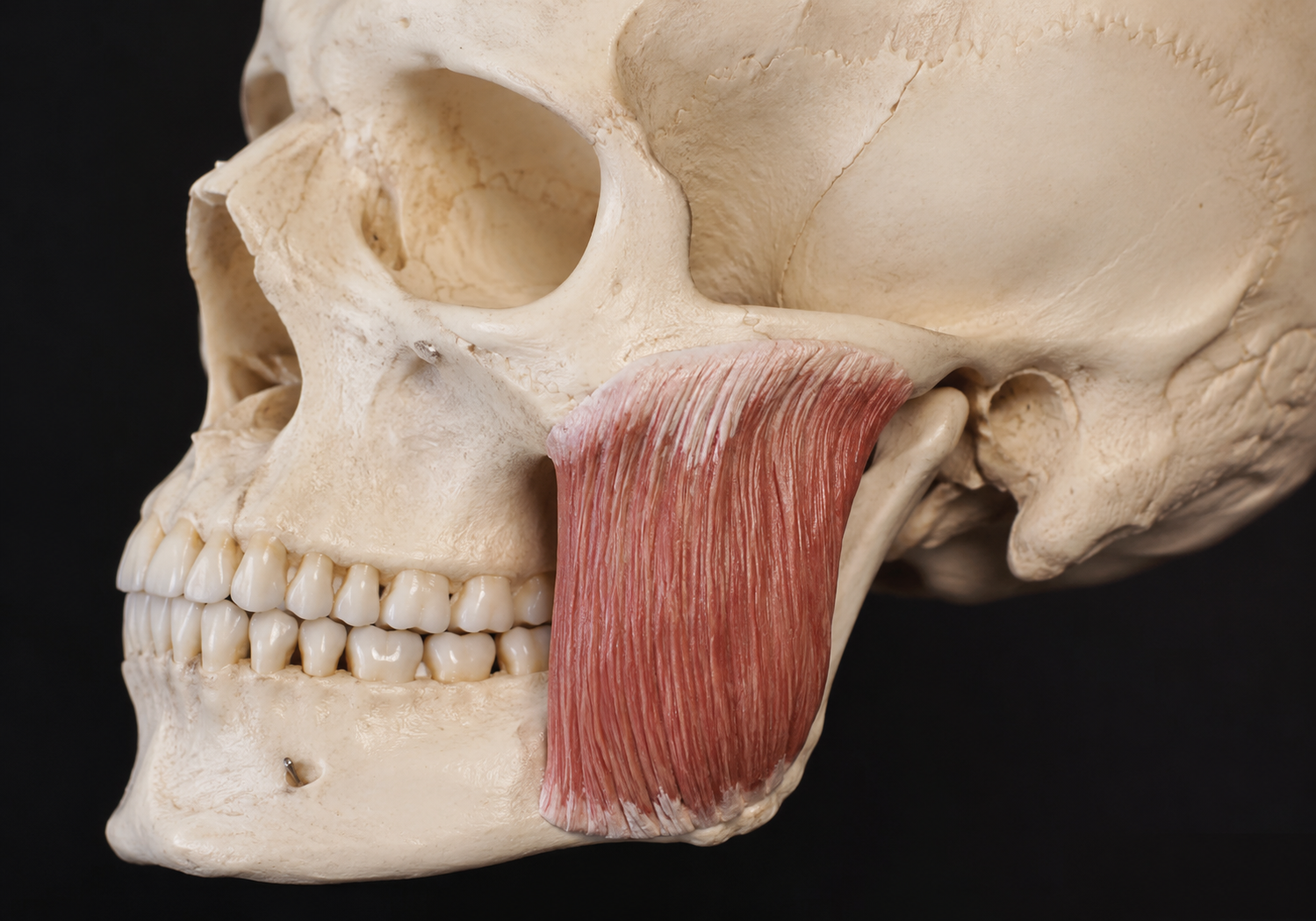
When anatomy textbooks talk about “strength relative to size,” they’re describing specific tension — and the undisputed champion here is the masseter, the thick, rectangular muscle that runs from your cheekbone to your lower jaw.
How a Jaw Muscle Becomes So Mighty
A few architectural secrets give the masseter its edge:
- Short lever arm. The masseter attaches close to the jaw joint, which means it doesn’t need to pull far to generate crushing force at the teeth. This mechanical advantage amplifies its output.
- Pennation architecture. Unlike strap-like muscles, the masseter’s fibers are arranged at an angle, like the vanes of a feather. This pennate structure allows it to pack more fibers into a smaller space. Because a muscle’s force capacity scales with its physiological cross-sectional area — not just its volume — pennation directly boosts specific tension. Both the masseter and its neighbor, the temporalis, share this design.
- Fiber composition. The masseter contains a high proportion of fast-twitch (type II) fibers, which generate rapid, powerful contractions — ideal for breaking down tough food.
The numbers are staggering: the masseter can produce bite forces exceeding 200 pounds (890 N) at the molars, yet its cross-sectional area is only a few square centimeters. That gives it a specific tension far above that of the gluteus or quadriceps. In fact, when all jaw-closing muscles work together, the combined bite force can surpass 600 N in women and 800 N in men — pressures that would damage other joints.
This relentless force is why your teeth are engineered to last a lifetime. To keep them resilient under that daily load, an electric toothbrush removes plaque more thoroughly than a manual brush, protecting the enamel and gum health that withstand your bite. Using a power toothbrush with a built-in pressure sensor also prevents aggressive overscrubbing — a common habit that can traumatize gums and, ironically, add unnecessary strain on that very masseter muscle.
Endurance and Lifetime Output: The Heart’s Quiet Dominance
If strength means “who works the longest without a break,” the heart is in a league of its own.
This fist-sized organ is made of cardiac muscle, a specialized type that contracts rhythmically and involuntarily. Unlike skeletal muscle, it never fatigues, never rests, and never gets a vacation day. Consider the math:
- It beats roughly 100,000 times per day
- That’s over 2.5 billion beats in a lifetime
- Each day it pumps about 2,500 gallons of blood, enough to fill a small swimming pool
- Over 80 years, that translates to moving more than 70 million gallons of blood
No other muscle comes close to this output. Even the diaphragm, which contracts more than 20,000 times a day to keep you breathing, eventually tires under extreme stress. The heart’s built-in pacemaker cells and dense mitochondrial networks lock it into a marathon that spans decades.
This endurance-centric definition of strength is vital in medicine. When doctors talk about “cardiac function,” they’re measuring the heart’s ejection fraction and stroke volume — essentially its lifelong strength performance. A weak heart muscle (cardiomyopathy) robs the body of oxygen, while a healthy one quietly delivers peak performance with zero willpower required.
The Final Verdict
So, what is the strongest muscle in the human body?
The real answer: There isn’t one. There are only champions in different strength events:
| Criteria | Winner | Why |
|---|---|---|
| Absolute force | Gluteus maximus | Moves the whole body against gravity with massive cross-sectional area |
| Pound-for-pound power | Masseter | Pennate architecture and short lever arm create jaw-dropping specific tension |
| Lifetime endurance | Heart | Beats continuously for decades without rest; pumps millions of gallons of blood |
Don’t let the question fool you. The body has evolved specialized muscles for specialized jobs. The gluteus powers you up a mountain, the masseter cracks a nut, the heart keeps every cell alive — and each is the strongest at what it does.
The next time someone asks this question, you can skip the single-word answer and share the far more fascinating truth: strength isn’t one thing. It’s a symphony of different abilities, each muscle perfectly tuned to its role. And that, arguably, is the strongest design of all.


Leave a comment
This site is protected by hCaptcha and the hCaptcha Privacy Policy and Terms of Service apply.